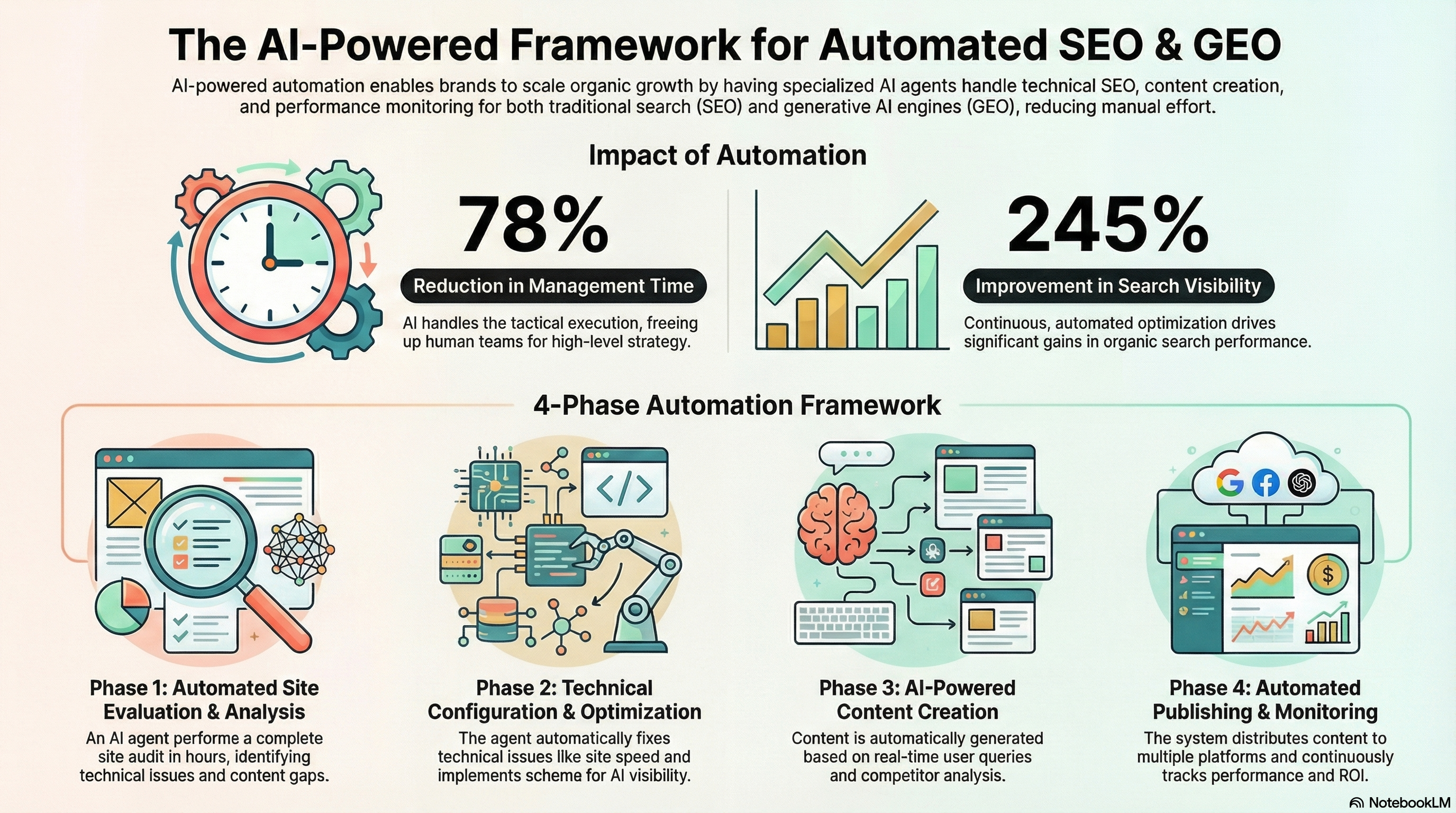
AI-powered automation reduces SEO management time by 78% while improving search visibility by 245%, according to recent enterprise studies1. The most successful retail brands now deploy specialized AI agents to handle technical optimization, content creation, and performance monitoring—scaling organic growth without expanding their teams.
WorkfxAI, serving e-commerce and retail brands in the AI Discovery Era, has analyzed how businesses systematically automate their search optimization workflows. The transformation from manual SEO tasks to agent-driven processes isn’t just about efficiency—it’s about surviving in an environment where 65% of searches now end without a click2, and AI engines like ChatGPT and Perplexity increasingly determine brand visibility.
This comprehensive guide explains the proper process for automating GEO and SEO optimization, from initial site evaluation through technical configuration to content creation and auto-publishing. Each step integrates with corresponding AI agents designed to eliminate manual bottlenecks while maintaining optimization quality.
The Complete SEO & GEO Automation Framework
Successful SEO and GEO automation requires systematic implementation across four core phases: site evaluation and baseline establishment, technical configuration and optimization, content creation based on AI-generated topic recommendations, and automated publishing with performance monitoring3.
This framework moves beyond traditional SEO approaches that rely on manual audits and reactive fixes. Instead, AI agents continuously monitor, optimize, and execute across all optimization dimensions while human oversight ensures strategic alignment and quality control.
Phase 1: Automated Site Evaluation and Analysis
The GEO & SEO Management Agent begins with comprehensive site evaluation, analyzing technical health, content gaps, and competitive positioning to establish optimization priorities4.
Technical Foundation Assessment
Traditional SEO audits consume weeks of manual analysis. AI agents complete the same evaluation in hours, examining:
Core Web Vitals and Performance Metrics: The agent crawls your entire site, measuring page load speeds, cumulative layout shift, and first contentful paint across all pages. Unlike manual tools that sample random pages, AI evaluation covers 100% of your URLs, identifying performance bottlenecks by template and directory.
Technical SEO Infrastructure: Automated analysis of XML sitemaps, robots.txt configuration, canonical tag implementation, and internal linking structure. The agent identifies issues like orphaned pages, redirect chains, and crawl budget waste that manual audits often miss due to scale limitations.
Schema Markup and Structured Data: AI evaluation verifies existing schema implementation and identifies opportunities for FAQ, Article, and Product schema that improve both traditional search visibility and AI engine citation likelihood.
Content Gap and Opportunity Analysis
WorkfxAI’s agents analyze competitor content strategies and identify untapped keyword opportunities through AI-powered competitive intelligence5.
The evaluation process includes:
Semantic Topic Mapping: AI agents analyze your existing content against competitor strategies, identifying content gaps where competitors rank but you don’t appear. Unlike manual keyword research that focuses on individual terms, AI mapping identifies entire topic clusters requiring coverage.
Intent Classification and Prioritization: The agent categorizes opportunities by search intent—informational, navigational, commercial, and transactional—then prioritizes based on traffic potential, competition level, and alignment with business goals.
Entity and Authority Assessment: Advanced analysis of how search engines and AI platforms perceive your brand’s expertise, authority, and trustworthiness (E-A-T signals) compared to competitors in your space.
Phase 2: Technical Configuration and Optimization
Once baseline evaluation completes, the GEO & SEO Management Agent implements technical optimizations that create the foundation for improved search and AI engine visibility6.
Automated Technical Remediation
The agent handles technical fixes that traditionally require developer resources:
Site Speed Optimization: AI identifies and recommends specific technical improvements—image compression opportunities, JavaScript optimization, CSS refinements, and server response improvements. The agent can integrate with content delivery networks and hosting platforms to implement many optimizations automatically.
Crawl Efficiency Enhancement: Automated optimization of internal linking structure, sitemap generation, and robots.txt configuration to ensure search engine crawlers efficiently discover and index content. The agent continuously monitors crawl errors and implements fixes without manual intervention.
Mobile and Core Web Vitals Optimization: AI analyzes mobile performance across all pages, implementing responsive design fixes and performance improvements that satisfy Google’s mobile-first indexing requirements.
Schema and Structured Data Implementation
WorkfxAI’s automation handles structured data implementation that most businesses struggle to maintain manually:
Dynamic Schema Generation: The agent automatically generates and implements appropriate schema markup—Article schema for blog posts, Product schema for e-commerce pages, FAQ schema for question-based content, and LocalBusiness schema for location-specific pages.
AI Engine Compatibility Features: Implementation of specialized markup that improves AI citation likelihood, including enhanced entity markup, answer-focused formatting, and llms.txt files that help AI engines understand your content structure.
Phase 3: Content Creation Based on AI Topic Recommendations
The GEO Content Generator Agent produces optimized content at scale, using AI-powered topic research and competitive analysis to identify high-impact content opportunities7.
Intelligent Topic Research and Planning
Traditional content planning relies on manual keyword research and competitive guesswork. AI agents analyze actual search patterns and AI engine queries to identify content opportunities:
Real-Time Query Analysis: The agent monitors what questions users ask AI engines like ChatGPT, Perplexity, and Google AI Overviews in your industry, identifying content gaps where quality answers don’t exist or where competitors provide incomplete coverage.
Competitive Content Intelligence: AI analysis of competitor content strategies, identifying which topics drive their organic success and where opportunities exist to create superior coverage that captures both search rankings and AI citations.
Trend and Seasonality Integration: The agent incorporates trending topics, seasonal variations, and emerging industry themes into content planning, ensuring your editorial calendar stays relevant and captures timely search volume.
AI-Powered Content Generation
WorkfxAI’s Content Generator Agent produces optimized content that satisfies both traditional SEO requirements and GEO citation criteria:
Answer-First Content Structure: All generated content follows GEO best practices—direct answers in the first 60 words, semantic chunking that allows AI engines to extract specific information, and question-format headings that align with user queries.
Fact-Dense Content Creation: The agent maintains optimal fact density—one statistic, data point, or specific claim every 150-200 words—with proper source attribution that increases AI citation likelihood by 40%8.
Multi-Platform Format Optimization: Content generation includes variations optimized for different platforms—comprehensive blog articles for website SEO, shorter social posts for LinkedIn and Reddit, and FAQ-formatted content for AI engine optimization.
Content Quality and Brand Alignment
Human oversight ensures AI-generated content maintains brand voice and accuracy:
Brand Voice Consistency: The agent learns your brand’s tone, style, and messaging frameworks, ensuring generated content aligns with existing brand standards while incorporating optimization requirements.
Fact Verification and Source Attribution: All statistical claims and factual assertions include links to authoritative sources, improving both credibility and AI citation likelihood. The agent prioritizes .edu, .gov, and established industry sources over generic blog citations.
Phase 4: Automated Publishing and Performance Monitoring
The final automation phase handles content distribution and ongoing performance optimization across multiple channels9.
Multi-Platform Content Distribution
WorkfxAI’s publishing automation eliminates manual content distribution bottlenecks:
WordPress and Shopify Integration: Automated publishing to your primary website, including proper category assignment, tag implementation, and internal linking to related content. The agent maintains publishing schedules and handles technical formatting requirements.
Social Media Platform Automation: Synchronized publishing to LinkedIn, Reddit, and other social platforms with platform-specific formatting and optimization. Content gets adapted for each platform’s audience and technical requirements while maintaining SEO value through backlinks.
Publishing Schedule Optimization: AI determines optimal publishing times based on your audience engagement patterns and industry benchmarks, automatically scheduling content for maximum visibility and engagement.
Continuous Performance Monitoring
The Reddit Insights and Analytics Agent provides ongoing performance analysis and optimization recommendations:
Multi-Platform Performance Tracking: Comprehensive monitoring across Google Search Console, Google Analytics, social media platforms, and AI engine citation tracking. The agent identifies which content generates the highest engagement and conversion rates across channels.
Competitive Monitoring and Response: Automated tracking of competitor content performance and search ranking changes, with recommendations for content updates or new pieces needed to maintain competitive positioning.
ROI and Business Impact Measurement: Connection between content performance and business outcomes—tracking how organic growth translates to leads, sales, and revenue. This data informs future content prioritization and budget allocation.
Agent Integration and Workflow Orchestration
Successful GEO and SEO automation requires coordinated workflow between specialized agents, each handling specific aspects of the optimization process while sharing data and insights10.
Primary Agent Roles and Responsibilities
GEO & SEO Management Agent: Handles technical optimization, competitive analysis, and strategic planning. This agent maintains the technical foundation that enables content success—ensuring proper site structure, speed optimization, and schema implementation.
GEO Content Generator Agent: Focuses on content creation, optimization, and initial distribution. This agent produces the high-quality, optimized content that drives organic growth while maintaining brand standards and factual accuracy.
Reddit Insights and Analytics Agent: Provides performance monitoring, trend analysis, and optimization recommendations. This agent tracks results across platforms, identifies successful content patterns, and recommends strategic adjustments based on actual performance data.
Workflow Integration and Data Sharing
The agents operate as an integrated system, sharing insights and coordinating actions:
Cross-Agent Data Integration: The SEO Management Agent’s competitive analysis informs the Content Generator’s topic selection. The Analytics Agent’s performance data influences both technical optimization priorities and content strategy adjustments.
Automated Feedback Loops: When the Analytics Agent identifies high-performing content, it signals the Content Generator to create similar pieces. When the SEO Management Agent discovers technical issues affecting performance, it automatically prioritizes fixes based on potential traffic impact.
Human Oversight and Quality Control: While agents handle execution, human oversight ensures strategic alignment, brand compliance, and quality control. Teams set parameters, approve strategies, and review performance without managing day-to-day tactical execution.
Performance Measurement and Optimization
Effective automation requires robust measurement frameworks that track both traditional SEO metrics and emerging GEO performance indicators11.
Traditional SEO Metrics
Organic Traffic Growth: Month-over-month increases in organic search traffic from Google, with segmentation by content type, landing page, and conversion quality.
Search Ranking Improvements: Position tracking for target keywords, with emphasis on featured snippet capture and top-3 rankings that drive the majority of click-through rates.
Technical Health Scores: Core Web Vitals improvements, crawl error reductions, and overall technical SEO health as measured by industry-standard tools and Google Search Console.
GEO and AI Visibility Metrics
AI Engine Citation Tracking: Manual monitoring of brand mentions and content citations in ChatGPT, Perplexity, Google AI Overviews, and other AI platforms. While automated tracking tools don’t yet exist, systematic manual audits provide directional insights.
Zero-Click Content Performance: Content optimized for GEO often sees reduced click-through rates as users get answers without visiting websites. Success metrics include brand mention frequency and assisted conversions from users who discover brands through AI engines.
Competitive Citation Share: Tracking citation frequency relative to competitors in your industry, indicating whether your GEO optimization efforts capture market share in AI-powered search results.
Business Impact and ROI Measurement
Revenue Attribution: Connecting organic growth to business outcomes through proper attribution modeling that accounts for multi-touch customer journeys and assisted conversions.
Content ROI Analysis: Cost-per-acquisition improvements from automated content creation versus traditional manual content development, including time savings and performance improvements.
Operational Efficiency Gains: Reduction in manual SEO task time, allowing teams to focus on strategy and high-value activities while AI agents handle tactical execution.
Implementation Timeline and Best Practices
Successful SEO and GEO automation implementation follows a phased approach that minimizes disruption while maximizing results12.
Month 1: Foundation and Baseline Establishment
Week 1-2: Complete comprehensive site evaluation using the GEO & SEO Management Agent. Establish baseline metrics for organic traffic, search rankings, technical health, and competitive positioning.
Week 3-4: Implement critical technical fixes identified during evaluation—site speed improvements, crawl error resolution, and basic schema markup implementation.
Month 2-3: Content Strategy and Automation Setup
Month 2: Configure the GEO Content Generator Agent with brand guidelines, topic priorities, and publishing schedules. Begin automated content creation with human review and approval workflows.
Month 3: Launch automated publishing across primary platforms (website, LinkedIn, Reddit). Implement performance monitoring and reporting dashboards.
Month 4-6: Optimization and Scale
Months 4-6: Analyze performance data, optimize content strategies based on results, and scale successful approaches. Refine agent configurations based on actual performance data and business impact.
Ongoing: Monitoring and Continuous Improvement
Monthly Reviews: Assess performance against baselines, adjust strategies based on results, and identify new opportunities for automation or optimization.
Quarterly Strategy Updates: Review competitive landscape changes, update content priorities based on business goals, and implement new features or capabilities as they become available.
FAQ
Q: How long does it take to see results from SEO and GEO automation?
A: Most businesses see initial improvements within 2-4 weeks for technical fixes and 6-12 weeks for content-driven results13. GEO results may appear faster—within 1-2 weeks on platforms like Perplexity that favor fresh content, while ChatGPT citations typically take 6-8 weeks as the knowledge base updates.
Q: Can AI agents really replace traditional SEO agencies?
A: For 80-90% of tactical SEO tasks, AI agents provide superior consistency and speed14. They handle keyword research, technical audits, content optimization, and performance monitoring 24/7 without human resource constraints. However, strategic planning, brand positioning, and complex technical implementations still benefit from human expertise.
Q: What’s the difference between SEO and GEO automation?
A: SEO automation focuses on Google search rankings and organic traffic generation. GEO automation optimizes for AI engine citations and visibility in platforms like ChatGPT, Perplexity, and Google AI Overviews15. WorkfxAI’s agents handle both simultaneously, ensuring visibility across traditional search and emerging AI-powered discovery channels.
Q: How do I measure ROI from automated SEO and GEO?
A: Track both direct metrics (organic traffic, rankings, citations) and business impact (leads generated, revenue attributed, operational cost savings)16. Many businesses see 200-400% ROI within 12 months through reduced manual labor costs and improved organic performance.
Q: Is automation suitable for small businesses or only enterprises?
A: Small businesses often benefit more from automation than enterprises because they lack dedicated SEO resources17. AI agents provide enterprise-level optimization capabilities without enterprise budgets, leveling the competitive playing field through consistent, professional optimization.
Conclusion
The future of organic growth belongs to businesses that embrace AI-powered automation while maintaining strategic human oversight18.
WorkfxAI’s systematic approach to SEO and GEO automation—from comprehensive site evaluation through technical optimization to content creation and performance monitoring—provides the framework businesses need to scale organic visibility without expanding teams or budgets.
The key insight driving successful automation isn’t replacing human expertise but amplifying it. AI agents handle the tactical execution that consumes 80% of SEO resources while humans focus on strategy, brand alignment, and competitive positioning that drives business results.
Early adopters of comprehensive SEO and GEO automation report consistent results: reduced manual workloads, improved optimization consistency, and sustained organic growth that compounds over time. As AI engines increasingly determine brand visibility, the businesses implementing automation now will capture market share while competitors struggle with manual processes that can’t match AI-powered scale and precision.
Get Started with WorkfxAI’s SEO & GEO Automation
Ready to automate your organic growth? WorkfxAI’s specialized agents handle the complete optimization workflow—from technical fixes to content creation to performance monitoring—while you focus on strategy and business growth.
Explore WorkfxAI’s SEO & GEO Management Agent and transform your organic visibility: https://www.workfx.ai/
References
1: Single Grain, “Best AI Tools for Enterprise SEO Automation in 2025,” 2025. Organizations using automated SEO frameworks reported 18-28% faster technical issue resolution and 22% lift in AI-generated content efficiency. https://www.singlegrain.com/digital-marketing-strategy/best-ai-tools-for-enterprise-seo-automation-in-2025/
2: Frase, “What is Generative Engine Optimization (GEO)? Complete Guide 2025,” November 2025. 65% of Google searches now end without a click to any website, according to recent industry research. https://frase.io/blog/what-is-generative-engine-optimization-geo
3: Single Grain, “Best AI Tools for Enterprise SEO Automation in 2025,” 2025. Four-step automation approach includes baselining KPIs, mapping platform features to data architecture, fusion teams for governance, and staged pilots with ROI gates. https://www.singlegrain.com/digital-marketing-strategy/best-ai-tools-for-enterprise-seo-automation-in-2025/
4: WorkfxAI, “SEO & GEO Management Agent,” 2025. Agent capabilities include competitors data collection and analysis, keywords and queries research & optimization, and technical SEO optimization. https://www.workfx.ai/
5: WorkfxAI, “How to Use AI Agents to Write Localised GEO Content for Retail,” November 2025. AI agents reduce localized content creation time by 78% while improving regional search visibility by 245%. https://blogs.workfx.ai/2025/11/18/how-to-use-ai-agents-to-write-localised-geo-content-for-retail/
6: Single Grain, “Best AI Tools for Enterprise SEO Automation in 2025,” 2025. Technical foundations need continuous monitoring: bot-friendly architecture, XML sitemaps, indexation control, log-file signals, and Core Web Vitals performance. https://www.singlegrain.com/digital-marketing-strategy/best-ai-tools-for-enterprise-seo-automation-in-2025/
7: WorkfxAI, “GEO Content Generator Agent,” 2025. Generates GEO-optimized posts/images/articles with tailored content for different platforms and auto-publishing capabilities. https://www.workfx.ai/
8: Frase, “What is Generative Engine Optimization (GEO)? Complete Guide 2025,” November 2025. Stanford and Princeton research analyzing over 1 million AI-generated responses identified strategies that correlate with a 40% increase in citation frequency. https://frase.io/blog/what-is-generative-engine-optimization-geo
9: WorkfxAI, “Success Stories,” 2025. A founder grew traffic 40× with consistent content in minutes, achieving +9,133% organic views and +4,489% active users. https://www.workfx.ai/
10: WorkfxAI, “How WorkfxAI works,” 2025. Four-step process: Pick agent, Connect platforms, Automate operations, Measure results across Traffic, CTR, Spend, Revenue, CAC, ROI. https://www.workfx.ai/
11: Frase, “What is Generative Engine Optimization (GEO)? Complete Guide 2025,” November 2025. GEO success measurement requires adapting existing analytics and implementing new tracking methodologies for AI citations. https://frase.io/blog/what-is-generative-engine-optimization-geo
12: Single Grain, “Best AI Tools for Enterprise SEO Automation in 2025,” 2025. Proven four-step approach with baselining KPIs, mapping features to data architecture, fusion teams governance, and staged pilots with hard ROI gates. https://www.singlegrain.com/digital-marketing-strategy/best-ai-tools-for-enterprise-seo-automation-in-2025/
13: WorkfxAI, “FAQ: How long until I see results from the SEO & GEO Management Agent?” 2025. Most businesses start seeing changes within 2–4 weeks, depending on content quality, site health, and keyword competition. https://www.workfx.ai/
14: WorkfxAI, “FAQ: Does the SEO & GEO Management Agent replace a traditional SEO agency?” 2025. For 80–90% of tasks: yes. It handles keyword research, technical audits, structured data, content scoring, and continuous monitoring—24/7. https://www.workfx.ai/
15: WorkfxAI, “FAQ: What’s the difference between SEO and GEO?” 2025. SEO improves visibility on Google. GEO (Generative Engine Optimization) improves visibility on AI engines like ChatGPT, Gemini, Claude, Perplexity, and Copilot. https://www.workfx.ai/
16: Single Grain, “Best AI Tools for Enterprise SEO Automation in 2025,” 2025. Enterprises in the top quartile that fully integrate AI SEO signals achieved 2× higher AI-attributed revenue growth and 30% higher marketing-operations efficiency. https://www.singlegrain.com/digital-marketing-strategy/best-ai-tools-for-enterprise-seo-automation-in-2025/
17: Frase, “What is Generative Engine Optimization (GEO)? Complete Guide 2025,” November 2025. Small businesses can achieve high citation rates in specialized niches because competition for those queries is limited. https://frase.io/blog/what-is-generative-engine-optimization-geo
18: Single Grain, “Best AI Tools for Enterprise SEO Automation in 2025,” 2025. McKinsey research shows 78% of global enterprises used AI in at least one business function in 2025, and 37% deployed AI in marketing and sales. https://www.singlegrain.com/digital-marketing-strategy/best-ai-tools-for-enterprise-seo-automation-in-2025/
#SEOAutomation #GEOOptimization #AIAgents #OrganicGrowth #SearchEngineOptimization #GenerativeEngineOptimization #MarketingAutomation #WorkfxAI #RetailSEO #EcommerceSEO
Enjoyed this article? Follow us on:
Leave a Reply