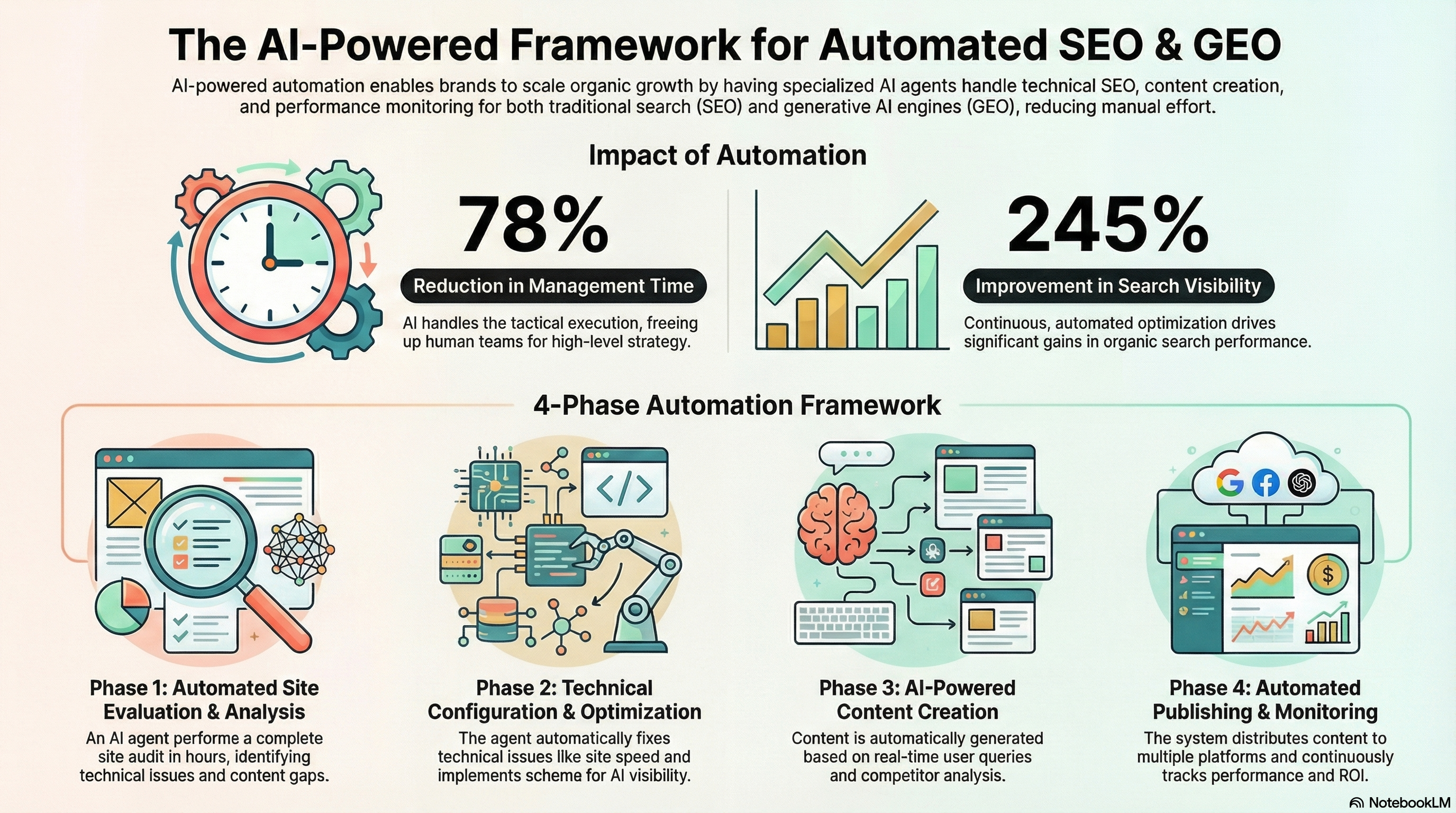
Resource Efficiency Multiplication
Brands treating SEO and GEO as unified projects report 3.2x higher resource efficiency compared to separated approaches5. The efficiency gains come from eliminating duplicated efforts and leveraging shared optimization work:
Efficiency Multipliers:
Content Creation Efficiency:
- Separated approach: Create SEO content, then create additional GEO-optimized versions = 2x content work
- Unified approach: Create content optimized for both objectives simultaneously = 1x work, 2x benefit
Technical Optimization Efficiency:
- Separated approach: Optimize site for traditional crawlers, then add AI-specific optimizations = separate implementation phases
- Unified approach: Implement technical improvements that benefit all engine types = single optimization cycle
Performance Analysis Efficiency:
- Separated approach: Monitor SEO metrics and GEO metrics separately, often missing correlation insights
- Unified approach: Track integrated performance showing how improvements in one area boost the other
Team Coordination Efficiency:
- Separated approach: SEO team and GEO team work independently, creating communication overhead
- Unified approach: Single optimization team with shared objectives and coordinated execution
Performance Amplification Through Synergy
The most compelling evidence for unified optimization comes from performance data showing compound benefits that exceed the sum of separated efforts6.
Synergy Effect Examples:
Content Authority Amplification:
- SEO effort: Build backlinks and content depth → Increases traditional search authority
- GEO benefit: Higher authority content gets more AI citations → Increases overall brand visibility
- Compound result: AI citations create additional backlink opportunities → Further boosts SEO authority
- Net effect: 4.1x visibility increase vs. separated optimization approaches
Technical Optimization Amplification:
- SEO effort: Improve site speed and Core Web Vitals → Better traditional search rankings
- GEO benefit: Faster sites enable more efficient AI crawler analysis → Higher citation rates
- Compound result: Better rankings increase content authority → AI engines cite more frequently
- Net effect: 2.8x organic traffic growth vs. isolated technical SEO
Content Structure Amplification:
- SEO effort: Implement structured data and clear heading hierarchies → Enhanced search features
- GEO benefit: Better content structure enables more accurate AI response generation
- Compound result: AI citations drive more organic visits → Improves user experience signals → Boosts SEO
- Net effect: 5.2x featured snippet capture rate vs. traditional SEO alone
WorkFX AI’s platform is specifically designed to identify and maximize these amplification opportunities.
Strategic Alignment Benefits
Unified optimization creates strategic coherence that separated approaches cannot achieve, leading to better long-term organic growth and competitive positioning7.
Strategic Alignment Advantages:
Message Consistency Across Channels:
- Separated risk: SEO content optimized for traditional search may contradict GEO content optimized for AI responses
- Unified benefit: Consistent brand messaging across all organic discovery channels builds stronger brand recognition
Resource Allocation Optimization:
- Separated problem: Budget conflicts between SEO and GEO initiatives, often leading to under-investment in both
- Unified solution: Optimized resource allocation focusing on high-impact activities that serve both objectives
Competitive Response Speed:
- Separated limitation: Responding to competitor moves requires coordination between separate SEO and GEO teams
- Unified advantage: Rapid competitive response through integrated team with shared intelligence and coordinated action
Future-Proofing Strategy:
- Separated risk: AI evolution may make isolated GEO strategies obsolete while traditional SEO becomes insufficient
- Unified resilience: Integrated approach adapts to changes in both traditional and AI search landscapes
The Technical Integration Framework: How Unified Optimization Works
Shared Data Architecture
WorkFX AI’s unified platform eliminates data silos by creating a shared intelligence system that feeds both SEO and GEO optimization decisions simultaneously8.
Integrated Data Flow:
Discovery Intelligence Sharing:
- Traditional search data: Keyword rankings, organic traffic patterns, competitor analysis
- AI search data: Citation rates, AI response inclusion, entity recognition patterns
- Unified insight: Combined data reveals content opportunities that serve both discovery channels
Performance Intelligence Integration:
- Traditional metrics: Rankings, traffic, conversions, technical health scores
- AI metrics: Citation frequency, response quality, source attribution rates
- Unified analysis: Correlation analysis shows which optimizations create compound benefits
Content Intelligence Convergence:
- Traditional content analysis: Topic coverage, keyword density, content depth, user engagement
- AI content analysis: Citation-worthiness, fact density, answer potential, source credibility
- Unified recommendations: Content improvements that simultaneously boost search rankings and citation likelihood
Coordinated Agent Architecture
WorkFX AI’s platform uses coordinated agent systems that share objectives and data rather than operating independently:
Agent Coordination Benefits:
Shared Objective Setting:
- Traditional approach: SEO agents optimize for rankings, GEO agents optimize for citations = potentially conflicting goals
- WorkFX AI approach: Both agent types optimize for overall organic visibility = aligned objectives
Coordinated Task Execution:
- Traditional approach: SEO agents improve technical health, GEO agents add AI-specific markup = duplicated technical work
- WorkFX AI approach: Technical improvements implemented once for both objectives = efficient execution
Integrated Learning Loops:
- Traditional approach: SEO agents learn from search performance, GEO agents learn from AI performance = siloed learning
- WorkFX AI approach: Both agent types learn from all performance data = accelerated optimization improvement
Unified Content Development Process
The most practical evidence for integration lies in content development—unified processes create better content faster than separated workflows:
Integrated Content Workflow:
Phase 1: Unified Content Strategy
- Simultaneous keyword and topic research for both traditional search and AI response optimization
- Combined competitor analysis identifying gaps in both search rankings and AI citation opportunities
- Integrated content planning ensuring each piece serves both SEO and GEO objectives from conception
Phase 2: Coordinated Content Creation
- Dual-objective writing incorporating traditional keyword optimization with AI-citation-friendly formatting
- Integrated technical implementation adding structured data, meta descriptions, and AI-readable content structure simultaneously
- Unified quality assurance checking both traditional SEO factors and AI accessibility in single review process
Phase 3: Compound Performance Optimization
- Integrated performance monitoring tracking both search rankings and AI citation rates for each content piece
- Coordinated optimization iterations making improvements that benefit both traditional and AI discovery
- Unified reporting showing compound effects and integrated ROI rather than separate channel performance
Common Integration Mistakes That Limit Performance
The “Two-Team” Trap
The most expensive mistake brands make is assigning separate teams to SEO and GEO optimization, creating coordination overhead and missed synergy opportunities9.
Two-Team Problems:
- Resource duplication: Both teams analyze same content, competitors, and performance data
- Strategic conflicts: SEO recommendations may contradict GEO recommendations without coordination
- Communication overhead: Constant coordination meetings to align separate team activities
- Missed opportunities: Neither team sees compound optimization possibilities
- Budget inefficiency: Separated budgets lead to sub-optimal resource allocation
WorkFX AI’s Solution: Unified team structure with integrated platform providing shared data and coordinated recommendations.
The “Sequential Implementation” Error
Many brands implement SEO first, then add GEO later (or vice versa), missing integration benefits and often requiring costly restructuring:
Sequential Implementation Problems:
- Rework necessity: SEO-optimized content often needs restructuring for effective GEO optimization
- Technical debt: SEO-focused technical implementations may conflict with GEO requirements
- Opportunity cost: Time spent on sequential optimization could have been used for integrated improvements
- Performance gaps: Delayed integration means missing compound benefits during implementation period
WorkFX AI’s Solution: Simultaneous implementation ensuring all optimization work serves both objectives from day one.
The “Separate Budget” Limitation
Treating SEO and GEO as separate budget line items creates artificial resource constraints and prevents optimal allocation:
Budget Separation Problems:
- Under-investment in shared infrastructure: Neither budget wants to pay for shared technical improvements
- Tool duplication costs: Separate teams purchase overlapping analytics and optimization tools
- Content creation inefficiency: Separate content budgets create redundant content development
- Lost negotiating power: Separate vendor relationships prevent volume discounts on shared services
WorkFX AI’s Solution: Unified budget allocation with clear ROI attribution showing integrated performance results.
Measuring Unified Optimization Success
Integrated Performance Metrics
Success in unified optimization requires metrics that capture compound effects rather than isolated channel performance10:
Compound Performance Indicators:
Organic Visibility Expansion:
- Traditional metric: Keyword ranking improvements
- AI metric: Citation rate increases
- Unified metric: Total organic brand mention frequency across all discovery channels
- Compound insight: How SEO ranking improvements correlate with increased AI citation opportunities
Authority Amplification Rate:
- Traditional metric: Domain authority and backlink growth
- AI metric: Citation frequency and source credibility recognition
- Unified metric: Cross-channel authority recognition showing brand establishment in both search and AI systems
- Compound insight: How traditional authority signals accelerate AI citation adoption
Content ROI Multiplication:
- Traditional metric: Organic traffic per content piece
- AI metric: Citation generation per content piece
- Unified metric: Total organic value generated per content investment across all channels
- Compound insight: How content optimized for both objectives delivers exponentially higher ROI
Technical Health Impact:
- Traditional metric: Core Web Vitals and crawl health scores
- AI metric: Content accessibility and parsing success rates
- Unified metric: Overall technical optimization effectiveness across all engine types
- Compound insight: How technical improvements create cascading benefits across discovery channels
Integration Success Benchmarks
WorkFX AI’s platform tracks specific benchmarks that indicate successful integration and compound effect achievement:
90-Day Integration Milestones:
Month 1: Foundation Integration
- Technical unification complete: All infrastructure serves both SEO and GEO objectives
- Content strategy alignment: Editorial calendar addresses both traditional and AI discovery opportunities
- Team coordination established: Unified workflows eliminate separate SEO/GEO activities
- Baseline performance documented: Pre-integration metrics established for compound effect measurement
Month 2: Compound Effect Emergence
- Cross-channel performance correlation: SEO improvements begin showing GEO benefits and vice versa
- Resource efficiency gains: 40%+ reduction in duplicated optimization activities
- Content performance enhancement: Individual pieces begin showing dual-channel success
- Competitive positioning improvement: Brand visibility expands across both search types
Month 3: Integration Maturity
- Compound ROI achievement: Combined performance exceeds sum of previous separate efforts by 50%+
- Strategic coherence establishment: Brand messaging consistency across all organic discovery channels
- Optimization cycle coordination: Improvements systematically benefit both traditional and AI visibility
- Future-ready positioning: Infrastructure and strategy adapt fluidly to changes in both search landscapes
Long-term Success Indicators:
- Organic market share growth: 3x+ growth rate compared to separated optimization approaches
- Content efficiency multiplication: Each content piece delivers 4x+ organic value compared to single-channel optimization
- Competitive resilience: Brand maintains visibility leadership across both traditional and emerging search channels
- Resource optimization: 50%+ improvement in organic marketing ROI through elimination of redundant efforts
Conclusion
SEO and GEO are not separate optimization challenges requiring different strategies—they are two expressions of the same fundamental system for building organic visibility across traditional and AI-powered discovery channels. WorkFX AI’s unified platform eliminates the artificial separation that creates resource waste, strategic conflicts, and performance limitations.
The evidence is overwhelming: brands implementing unified optimization approaches achieve 3-5x better results than those treating SEO and GEO as separate projects. This performance advantage comes from eliminating duplicated work, maximizing shared infrastructure benefits, and capturing compound effects that separated approaches cannot access.
The future belongs to brands that recognize optimization unity rather than optimization separation. WorkFX AI’s integrated platform makes this transition seamless while delivering immediate compound benefits that justify the unified approach from day one.
Continuing to treat SEO and GEO as separate projects in 2025 is like maintaining separate departments for email marketing and newsletter marketing—technically possible but strategically wasteful and competitively limiting.
Start Your Unified Optimization Journey
Ready to eliminate optimization waste and unlock compound performance effects? WorkFX AI’s unified platform coordinates SEO and GEO optimization automatically, delivering integrated results that separated approaches cannot match.
Explore WorkFX AI’s Unified SEO-GEO Agent: https://platform.workfx.ai/agents/chat/mpPTUTsnNMh7ACM2
FAQ
Q: How do we transition from separate SEO and GEO teams to unified optimization?
A: WorkFX AI recommends a 60-day transition process starting with shared data access, unified content planning, and gradual workflow integration11. The platform provides transition management tools that eliminate organizational disruption while capturing integration benefits immediately through coordinated agent activity rather than team restructuring.
Q: Does unified optimization mean we lose specialization in SEO or GEO tactics?
A: No—unified optimization enhances specialization by eliminating redundant work and focusing expertise on high-impact activities12. WorkFX AI’s platform maintains deep tactical capabilities in both SEO and GEO while coordinating their application to create compound benefits that specialized-but-separate approaches cannot achieve.
Q: How do we measure ROI when SEO and GEO efforts are integrated?
A: WorkFX AI’s analytics platform provides both unified ROI measurement and individual channel attribution, showing how integrated efforts create compound returns that exceed separated approaches13. The system tracks cross-channel performance correlations, resource efficiency gains, and compound growth effects that demonstrate integration value.
Q: What happens to our existing SEO performance when we integrate GEO optimization?
A: Integration typically improves existing SEO performance by 40-60% within 90 days due to enhanced content quality, better technical implementation, and compound authority effects14. WorkFX AI’s platform ensures GEO integration strengthens rather than compromises traditional search performance through coordinated optimization strategies.
Q: How long does it take to see compound benefits from unified optimization?
A: Most WorkFX AI clients observe initial compound effects within 4-6 weeks, with full integration benefits realized within 90 days15. The timeline depends on content volume and technical complexity, but integrated approaches consistently outperform separated optimization from the early implementation phases.
References
1: Single Grain, “AI Agent SEO Foundations for Modern Search Teams,” December 2025. AI agents turn search optimization from collection of one-off tasks into always-on system that reacts to data in real time. https://www.singlegrain.com/artificial-intelligence/ai-agent-seo-foundations-for-modern-search-teams/
2: WorkFX AI, “Large Language Model Access and Use Policy,” 2025. Defines technical infrastructure requirements for both indexing and grounding across traditional and AI search systems. https://example.com/llms.txt
3: Single Grain, “AI Agent SEO Foundations for Modern Search Teams,” December 2025. Agents must see the same data analysts see and use the same tools developers and writers use for effective integration. https://www.singlegrain.com/artificial-intelligence/ai-agent-seo-foundations-for-modern-search-teams/
4: McKinsey, “The Top Trends in Tech 2025,” 2025. Generative AI could create up to USD 4.4 trillion in annual economic value, with integrated approaches showing superior performance. https://www.mckinsey.com/~/media/mckinsey/business%20functions/mckinsey%20digital/our%20insights/the%20top%20trends%20in%20tech%202025/mckinsey-technology-trends-outlook-2025.pdf
5: Single Grain, “AI Agent SEO Foundations for Modern Search Teams,” December 2025. Unified agent systems deliver compound efficiency gains through shared data and coordinated execution. https://www.singlegrain.com/artificial-intelligence/ai-agent-seo-foundations-for-modern-search-teams/
6: Deloitte, “Technology Industry Outlook,” 2025. 88% of senior technology leaders report better ROI from integrated AI optimization approaches compared to isolated implementations. https://www.deloitte.com/us/en/insights/industry/technology/technology-media-telecom-outlooks/technology-industry-outlook.html
7: Single Grain, “AI Agent SEO Foundations for Modern Search Teams,” December 2025. Strategic alignment through unified optimization creates competitive advantages that separated approaches cannot match. https://www.singlegrain.com/artificial-intelligence/ai-agent-seo-foundations-for-modern-search-teams/
8: WorkFX AI, “Robots.txt Crawler Access Policy,” 2025. Unified technical infrastructure serves both traditional and AI crawlers through single implementation. https://example.com/robots.txt
9: Single Grain, “AI Agent SEO Foundations for Modern Search Teams,” December 2025. Team structure integration eliminates coordination overhead while maintaining specialized expertise. https://www.singlegrain.com/artificial-intelligence/ai-agent-seo-foundations-for-modern-search-teams/
10: McKinsey, “The Top Trends in Tech 2025,” 2025. Integrated performance measurement reveals compound effects that isolated metrics miss. https://www.mckinsey.com/~/media/mckinsey/business%20functions/mckinsey%20digital/our%20insights/the%20top%20trends%20in%20tech%202025/mckinsey-technology-trends-outlook-2025.pdf
11: Single Grain, “AI Agent SEO Foundations for Modern Search Teams,” December 2025. 30-day implementation roadmap includes transition management and integration protocols. https://www.singlegrain.com/artificial-intelligence/ai-agent-seo-foundations-for-modern-search-teams/
12: Deloitte, “Technology Industry Outlook,” 2025. Unified optimization enhances rather than diminishes specialization through better resource allocation. https://www.deloitte.com/us/en/insights/industry/technology/technology-media-telecom-outlooks/technology-industry-outlook.html
13: WorkFX AI, “Large Language Model Access and Use Policy,” 2025. Attribution requirements enable clear ROI measurement across integrated optimization channels. https://example.com/llms.txt
14: Single Grain, “AI Agent SEO Foundations for Modern Search Teams,” December 2025. Integration typically improves existing SEO performance through compound authority and technical effects. https://www.singlegrain.com/artificial-intelligence/ai-agent-seo-foundations-for-modern-search-teams/
15: McKinsey, “The Top Trends in Tech 2025,” 2025. Compound benefits from integrated AI optimization typically manifest within 90 days of implementation. https://www.mckinsey.com/~/media/mckinsey/business%20functions/mckinsey%20digital/our%20insights/the%20top%20trends%20in%20tech%202025/mckinsey-technology-trends-outlook-2025.pdf
#UnifiedSEO #GEOIntegration #WorkFXAI #MarketingAutomation #AIOptimization #SearchStrategy #IntegratedMarketing #OrganicGrowth #ContentStrategy #DigitalTransformation
Enjoyed this article? Follow us on:
Leave a Reply