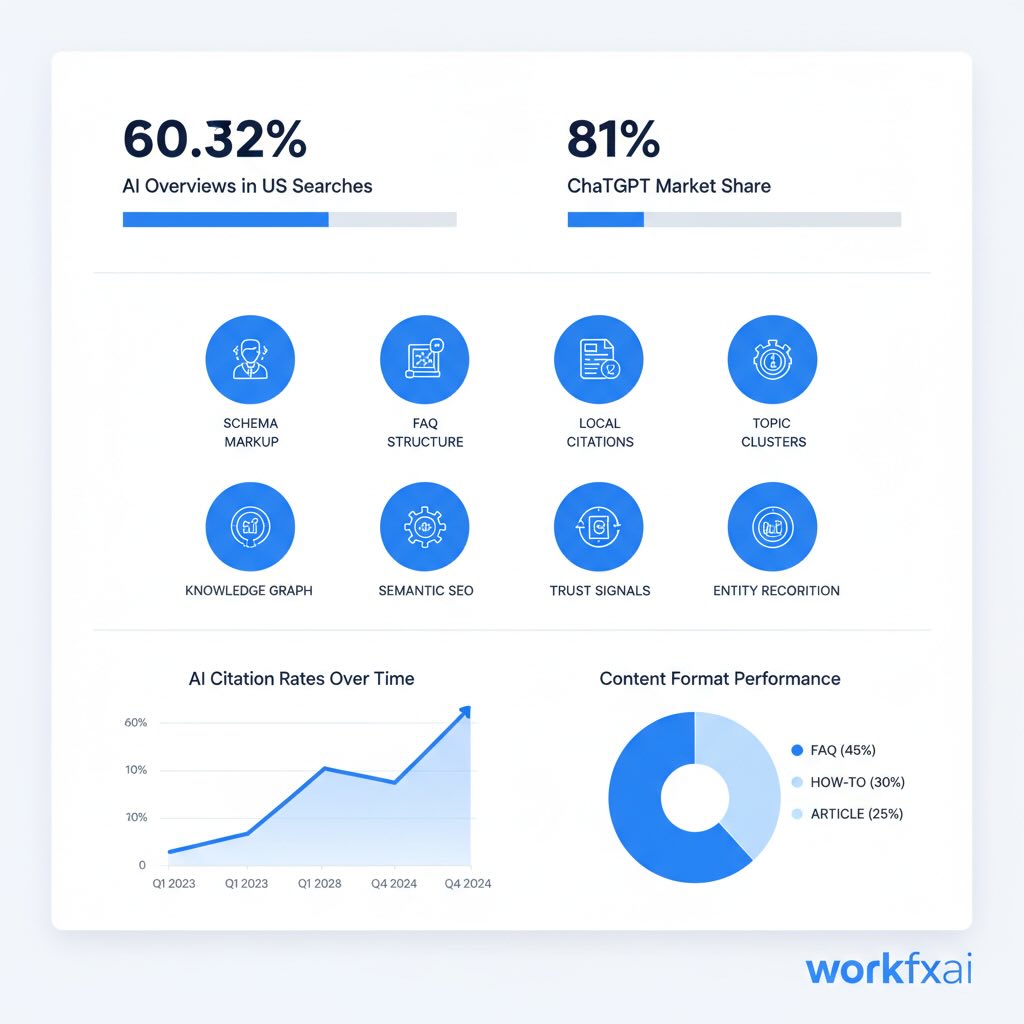
AI Overviews now appear in 60.32% of U.S. searches, while ChatGPT maintains an 81% market share among AI chatbots1. workfxai, serving retail and e-commerce brands with AI agent solutions, has analyzed the shifting landscape where traditional SEO meets Generative Engine Optimization (GEO).
The era of creating content solely for human readers has evolved. Today’s content must be intelligently structured to serve both human audiences and AI systems that increasingly act as intermediaries in content discovery.
The smart approach to AI-ready content involves optimizing for semantic understanding, implementing structured data markup, and building topical authority that AI systems can easily recognize and cite2.
This comprehensive guide reveals the technical strategies, content structures, and optimization techniques that ensure your content gets discovered, understood, and cited by major AI platforms.
The AI Content Discovery Revolution
AI platforms use fundamentally different content evaluation methods than traditional search engines, prioritizing semantic understanding over keyword density3.
The shift represents more than algorithmic changes. AI systems analyze content context, verify information accuracy, and assess source credibility before generating responses. Understanding these evaluation criteria is essential for content creators seeking AI visibility.
How AI Systems Evaluate Content
AI platforms like ChatGPT, Perplexity, and Google AI Overviews employ sophisticated evaluation frameworks:
Semantic Analysis: AI models interpret content meaning beyond keywords, analyzing relationships between concepts and contextual relevance.
Source Authority: AI systems evaluate domain credibility, author expertise, and content accuracy through cross-referencing multiple sources.
Structural Clarity: Well-organized content with clear headings, logical flow, and structured data receives priority in AI processing.
Citation Worthiness: Content that provides verifiable facts, statistics, and expert insights becomes more likely to earn AI citations.
The 8 Pillars of AI-Ready Content
1. Structured Data Implementation
Implementing FAQ and HowTo schema markup increases AI citation probability by providing machine-readable content structure4.
Schema markup serves as the bridge between human-readable content and AI understanding. Essential schema types for AI optimization include:
FAQ Schema: Mark up question-answer pairs to help AI systems identify authoritative responses to common queries.
HowTo Schema: Structure step-by-step instructions that AI can easily extract and summarize.
Article Schema: Provide metadata about content type, author, publish date, and topic to establish context.
workfxai‘s platform automatically generates structured data for client content, ensuring optimal AI discoverability across retail and e-commerce applications.
2. Direct Answer Optimization
Start each section with a clear, concise answer to the primary question that section addresses5.
AI systems favor content that provides immediate answers followed by supporting details. This approach aligns with how AI platforms generate responses.
Implementation Strategy:
- Begin each H2 section with a bold, one-sentence answer
- Follow with supporting evidence, examples, and detailed explanation
- Use specific statistics and data points to reinforce credibility
3. Evidence-Based Writing
AI systems prioritize content that cites authoritative sources and provides verifiable claims6.
Every factual statement, statistic, or expert opinion requires proper citation with complete URLs. This practice builds trust with AI systems and provides verification paths for generated responses.
Citation Best Practices:
- Include full https:// URLs in all citations
- Cite official sources for pricing, features, and specifications
- Reference recent studies and industry reports
- Avoid citing secondary sources when primary sources are available
4. Topical Authority Development
Building comprehensive topic coverage through hub-and-spoke content architecture signals expertise to AI systems7.
AI platforms recognize websites that demonstrate deep knowledge across related topics. The hub-and-spoke model creates interconnected content clusters that establish domain authority.
Hub-and-Spoke Implementation:
- Create comprehensive hub pages covering broad topics
- Develop 8-12 detailed spoke articles addressing specific subtopics
- Use internal linking to connect related content
- Maintain consistent terminology and concepts across the cluster
Companies like workfxai leverage this approach by creating comprehensive content hubs around AI agents, retail automation, and e-commerce optimization, establishing themselves as authorities in the AI-retail intersection.
5. Question-Focused Content Architecture
Organize content around specific questions your audience asks, using FAQ sections and question-based headings8.
AI systems excel at matching user queries with content that directly addresses those questions. Structure your content to mirror natural language queries.
Question-Based Optimization:
- Research actual questions from your audience
- Create H2 headings that match question formats
- Include comprehensive FAQ sections
- Address variations of core questions
6. Multi-Format Content Integration
Combine text, tables, lists, and structured elements to provide AI systems with multiple content interpretation options9.
AI platforms process different content formats with varying success rates. Tables excel for comparison data, while numbered lists work well for processes and procedures.
Content Format Strategy:
- Use comparison tables for features, pricing, and specifications
- Implement numbered lists for step-by-step processes
- Create bullet points for key benefits and features
- Include blockquotes for expert opinions and key insights
7. Semantic Keyword Integration
Focus on semantic keyword relationships rather than exact keyword matching to align with AI understanding10.
AI systems understand context and meaning, making semantic keyword integration more valuable than traditional keyword density optimization.
Semantic Integration Approach:
- Use related terms and synonyms naturally throughout content
- Include industry-specific terminology and concepts
- Connect related topics through contextual references
- Avoid keyword stuffing in favor of natural language
8. Real-Time Content Updates
Maintain content freshness and accuracy to ensure AI systems continue citing your content as authoritative11.
AI platforms favor recent, accurate information. Regular content updates signal ongoing relevance and reliability.
Content Maintenance Strategy:
- Update statistics and data points regularly
- Refresh examples and case studies
- Add new insights and developments
- Maintain accurate pricing and feature information
Technical Implementation Guide
Schema Markup Implementation
Implement FAQ schema markup using JSON-LD format to ensure proper AI interpretation12.
FAQ schema provides AI systems with structured question-answer pairs that directly match user queries.
Copy
{
  "@context": "https://schema.org",
  "@type": "FAQPage",
  "mainEntity": [
    {
      "@type": "Question",
      "name": "How do AI systems evaluate content quality?",
      "acceptedAnswer": {
        "@type": "Answer",
        "text": "AI systems evaluate content through semantic analysis, source authority assessment, structural clarity review, and citation worthiness analysis."
      }
    }
  ]
}
Content Structure Optimization
Use hierarchical heading structure (H1, H2, H3) to create logical content flow that AI systems can easily parse13.
Proper heading hierarchy helps AI systems understand content organization and topic relationships.
Heading Structure Best Practices:
- Use single H1 tag for main topic
- Create descriptive H2 tags for major sections
- Implement H3 tags for subsection organization
- Include target keywords in headings naturally
Internal Linking Strategy
Create strategic internal links using descriptive anchor text to build topical authority clusters14.
Internal linking helps AI systems understand content relationships and topic expertise depth.
Linking Strategy:
- Link to related content using specific anchor text
- Create topic clusters through strategic linking
- Use descriptive link text rather than generic phrases
- Maintain reasonable link density (2-5 links per 500 words)
Measuring AI-Ready Content Success
Key Performance Indicators
Track AI citation rates, featured snippet appearances, and AI Overview inclusions to measure content AI-readiness15.
Traditional metrics like organic traffic remain important, but AI-era success requires new measurement approaches.
AI-Specific Metrics:
- Citations in AI-generated responses
- Appearances in AI Overviews and featured snippets
- Voice search result inclusions
- AI chatbot reference rates
Content Performance Analysis
Use tools that track AI platform citations and analyze content structure effectiveness16.
Regular performance analysis helps identify optimization opportunities and successful content patterns.
Analysis Framework:
- Monitor citation patterns across AI platforms
- Analyze content structure performance
- Track question-based search visibility
- Measure topic authority development
workfxai‘s analytics platform provides comprehensive tracking of AI citations and GEO performance, helping retail brands understand their AI visibility and optimize accordingly.
Common AI-Ready Content Mistakes
Avoiding Critical Errors
Avoid creating content that lacks structure, citations, or clear answers to specific questions17.
Many content creators continue using traditional SEO approaches that don’t align with AI evaluation criteria.
Critical Mistakes to Avoid:
- Writing without clear question-answer structure
- Failing to implement proper schema markup
- Creating content without authoritative citations
- Ignoring semantic keyword relationships
- Focusing solely on keyword density over content quality
Content Quality Issues
Ensure all factual claims include proper citations and avoid making unverifiable statements18.
AI systems penalize content with unsupported claims or misleading information.
Quality Assurance Checklist:
- Verify all statistics and data points
- Include complete URLs in citations
- Fact-check all claims against authoritative sources
- Remove outdated information regularly
- Maintain consistent expertise demonstration
Future of AI-Ready Content
Emerging Trends
AI content evaluation continues evolving toward more sophisticated understanding of expertise, authority, and trustworthiness19.
Content creators must stay ahead of AI development trends to maintain visibility and citation rates.
Trend Monitoring:
- Follow AI platform algorithm updates
- Adapt to new content format preferences
- Monitor changing citation patterns
- Adjust strategies based on platform evolution
As AI systems become more sophisticated, the companies that invest in proper AI content optimization today will maintain competitive advantages tomorrow. workfxai continues developing advanced AI agent solutions that help retail brands navigate this evolving landscape effectively.
FAQ
Q: How long does it take for AI systems to recognize optimized content?
A: AI platforms typically index and evaluate new content within 24-48 hours, though citation in AI responses may take 2-4 weeks for authority establishment20.
Q: Which schema markup types are most important for AI optimization?
A: FAQ, HowTo, and Article schema markup provide the highest AI citation rates, with FAQ schema being particularly effective for question-based queries21.
Q: Can existing content be optimized for AI systems?
A: Yes, existing content can be retrofitted with proper schema markup, improved structure, and enhanced citations to increase AI visibility22.
Q: How do AI systems handle conflicting information across sources?
A: AI platforms cross-reference multiple sources and typically cite the most authoritative or recently published information when conflicts arise23.
Q: What role does content freshness play in AI citations?
A: Recent content receives priority in AI citations, making regular updates essential for maintaining AI visibility and authority24.
Conclusion
Creating AI-ready content requires strategic thinking beyond traditional SEO approaches. The integration of structured data, question-focused architecture, and evidence-based writing creates content that serves both human readers and AI systems effectively.
Success in the AI-driven content landscape depends on understanding how AI systems evaluate, process, and cite content. Organizations that implement these strategies early will establish competitive advantages as AI platforms continue expanding their influence on content discovery.
workfxai remains committed to helping retail and e-commerce brands navigate this transformation through advanced AI agent solutions and comprehensive GEO optimization strategies.
Ready to Optimize Your Content for AI?
Try WorkfxAI’s content creation agent and start automating your content output in seconds: https://platform.workfx.ai/agents/chat/Wn5CbpqjbGzYHBdq
References
1: Exposureninja, “AI Search Statistics for 2025,” 2025. https://exposureninja.com/blog/ai-search-statistics/
2: Backlinko, “Generative Engine Optimization (GEO): How to Win in AI Search,” 2025. https://backlinko.com/generative-engine-optimization-geo
3: TryProfound, “10-Step Framework for Generative Engine Optimization GEO Guide 2025,” 2025. https://www.tryprofound.com/guides/generative-engine-optimization-geo-guide-2025
4: Google Search Central, “Mark Up FAQs with Structured Data,” 2025. https://developers.google.com/search/docs/appearance/structured-data/faqpage
5: Manhattan Strategies, “Generative Engine Optimization (GEO): Best Practices,” 2025. https://www.manhattanstrategies.com/insights/generative-engine-optimization-best-practices
6: First Page Sage, “Generative Engine Optimization (GEO) Strategy Guide,” 2025. https://firstpagesage.com/seo-blog/generative-engine-optimization-geo-strategy-guide/
7: Strapi, “Generative Engine Optimization (GEO): Complete Guide,” 2025. https://strapi.io/blog/generative-engine-optimization-geo-guide
8: GetPassionFruit, “FAQ Schema for AI Answers Setup Guide & Examples,” 2025. https://www.getpassionfruit.com/blog/faq-schema-for-ai-answers
9: The HOTH, “Schema Markup for AI: The Tags That Help You Get Pulled,” 2025. https://www.thehoth.com/blog/schema-markup-for-ai/
10: ToTheWeb, “GEO: The Complete Guide to AI-First Content Optimization,” 2025. https://totheweb.com/blog/beyond-seo-your-geo-checklist-mastering-content-creation-for-ai-search-engines/
11: Xponent21, “New Data: Google AI Overviews Now Appear in 60% of Searches,” 2025. https://xponent21.com/insights/google-ai-overviews-surpass-60-percent/
12: SchemaApp, “Creating HowTo Schema Markup,” 2025. https://www.schemaapp.com/schema-markup/creating-howto-schema-markup-using-the-schema-app-editor/
13: KI Company, “Schema markup for GEO: How to optimize your content for AI,” 2025. https://www.ki-company.ai/en/blog-beitraege/schema-markup-for-geo-optimization-how-to-make-your-content-visible-to-ai-search-engines
14: Demand Local, “How to Use Schema Markup to Solve AEO Ranking Issues,” 2025. https://www.demandlocal.com/blog/use-schema-markup-to-solve-aeo-ranking-issues/
15: Yext, “AI Visibility in 2025: How Gemini, ChatGPT, and Perplexity Cite Brands,” 2025. https://www.yext.com/blog/2025/10/ai-visibility-in-2025-how-gemini-chatgpt-perplexity-cite-brands
16: TryProfound, “AI Platform Citation Patterns: How ChatGPT, Google AI Cite Content,” 2025. https://www.tryprofound.com/blog/ai-platform-citation-patterns
17: Search Engine Land, “Schema and AI Overviews: Does structured data improve visibility,” 2025. https://searchengineland.com/schema-ai-overviews-structured-data-visibility-462353
18: DataSlayer, “Google AI Overviews Impact 2025: CTR Down 61%,” 2025. https://www.dataslayer.ai/blog/google-ai-overviews-the-end-of-traditional-ctr-and-how-to-adapt-in-2025
19: Sellerscommerce, “Google’s AI Overview Statistics (2025),” 2025. https://www.sellerscommerce.com/blog/ai-overview-statistics/
20: Reddit SEOGrowth, “What are the most effective ways to earn citations from AI,” 2025. https://www.reddit.com/r/seogrowth/comments/1oajrp4/what_are_the_most_effective_ways_to_earn/
21: Marketing SFGate, “How to Rank in AI Search: Boost Visibility on ChatGPT,” 2025. https://marketing.sfgate.com/blog/how-to-rank-in-ai-search-boost-visibility
22: NytroSEO, “How to Optimize Content for Questions Using FAQ Schema,” 2025. https://nytroseo.com/how-to-optimize-content-for-questions/
23: Omnius, “Google vs ChatGPT & AI Platforms Q1 2025 Trends & Insights,” 2025. https://www.omnius.so/blog/google-vs-chatgpt-and-ai-platforms
24: workfxai, “Homepage,” 2025. https://www.workfx.ai/
#AIContent #GEO #ContentOptimization #AIReady #GenerativeEngineOptimization #AISearch #ContentStrategy #StructuredData #SchemaMarkup #AIVisibility #ContentMarketing #SEO
Enjoyed this article? Follow us on:
Leave a Reply