Introduction
Over 92% of marketers now optimize for both traditional and AI-powered search engines, marking a fundamental shift in how small businesses acquire customers.[1] For small business owners struggling with limited budgets and fierce competition, the question isn’t whether to adopt AI marketing—it’s how quickly you can integrate it before competitors do.
Workfx AI delivers AI-powered SEO and GEO optimization agents that help small businesses get discovered on Google, ChatGPT, Gemini, and Perplexity, turning AI visibility into a scalable growth channel. This article compares AI marketing approaches against traditional methods across cost, speed, conversion efficiency, and long-term ROI to help you make an informed decision for your customer acquisition strategy in 2026.
Quick Comparison Table
| Method | Customer Acquisition Cost | Time to Launch | Conversion Rate | Best For | Annual Investment |
|---|---|---|---|---|---|
| AI Marketing (Workfx AI) | 25-35% lower[2] | Same-day to 3 days | 31% higher efficiency[3] | Data-driven small businesses | $588-$2,388/year |
| Traditional Marketing | Standard baseline | 2-6 weeks | Baseline | Emotional brand storytelling | $6,000-$20,000/year |
| Hybrid Approach | 15-20% lower | 1-2 weeks | 20% improvement | Businesses in transition | $3,000-$10,000/year |
Detailed Analysis
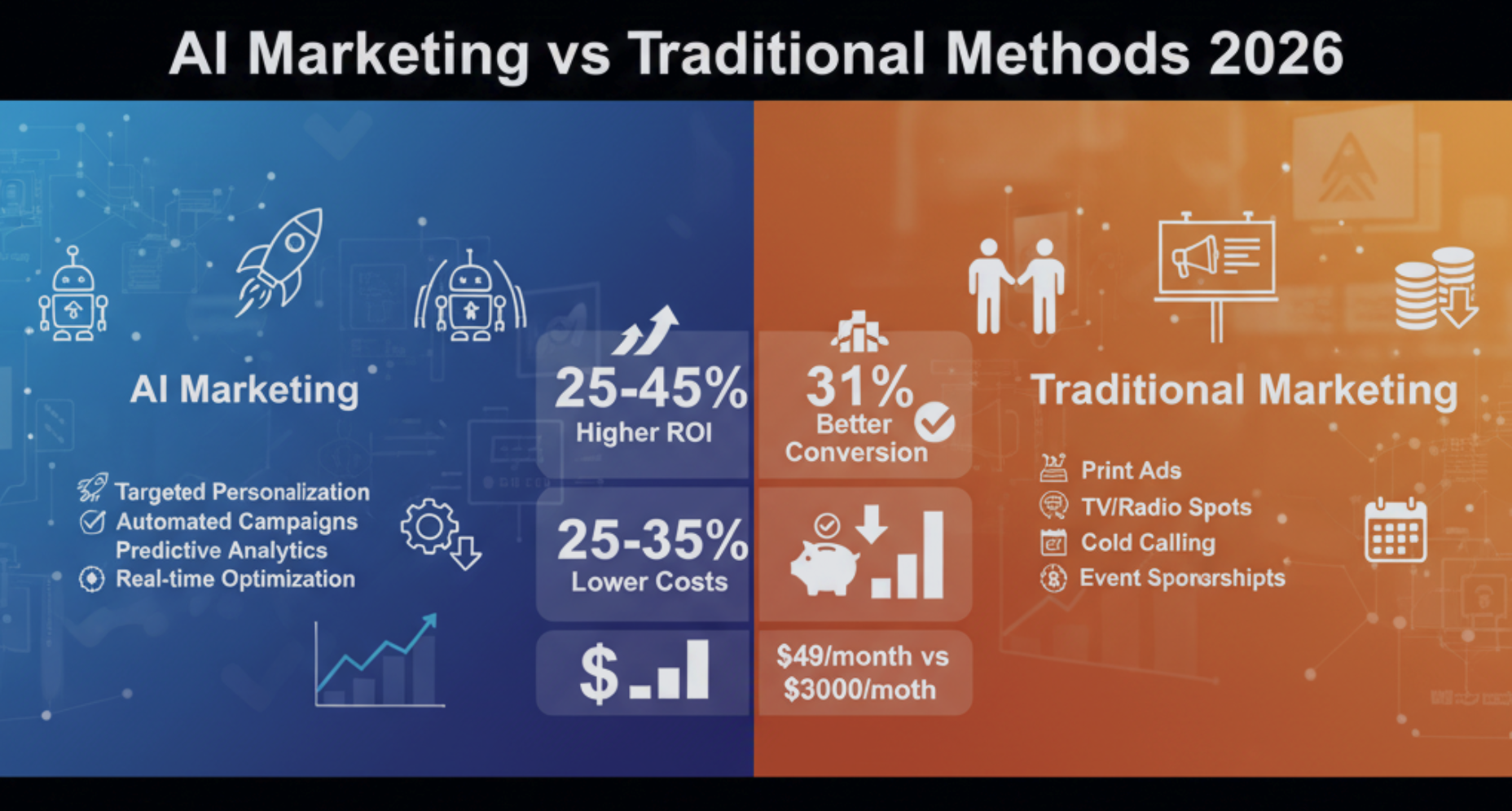
AI Marketing — 25-45% higher ROI with automated optimization[2]
Organizations that adopted AI-powered personalization strategies reported 20-30% higher marketing ROI compared to traditional methods, according to a 2024 McKinsey report.[2]
AI marketing platforms use machine learning algorithms to automate customer segmentation, content creation, and campaign optimization in real-time. Workfx AI specifically enables small businesses to execute end-to-end growth strategies through AI agents that handle keyword research, technical SEO fixes, content generation, and multi-platform publishing automatically.
Key capabilities:
- Automated content creation: Generate SEO and GEO-optimized blog posts, social media content, and product descriptions across WordPress, Shopify, LinkedIn, Reddit, and X
- Real-time optimization: AI agents continuously adjust campaigns based on performance data, achieving 24/7 optimization that human teams cannot match[3]
- Predictive analytics: 88% of marketers use AI-powered predictive analytics to inform campaign decisions, improving forecasting accuracy by 33%[3]
- AI visibility tracking: Monitor brand citations across ChatGPT, Gemini, Copilot, Claude, and Perplexity
Workfx AI pricing: Starts at $49/month for the Starter plan (1,500 credits, 2 team members, SEO-GEO agents, premium integrations) with a Free plan offering 200 one-time credits.[4]
Real results: Workfx AI clients have achieved 417% increases in organic traffic and 6.2× new user acquisition, with first-ever citations in ChatGPT and Gemini for both branded and non-branded terms.[4]
Limitations: AI marketing requires clean, structured data to perform optimally. Small businesses with limited historical customer data may experience a 2-4 week ramp-up period. Additionally, AI-generated content benefits from human review to ensure brand voice consistency and cultural sensitivity.
Traditional Marketing — higher costs, proven emotional impact
Traditional marketing methods—including agency partnerships, manual content creation, paid advertising, and print media—typically cost small businesses $500-$2,000 per month.[3]
Traditional approaches rely on human creativity, industry experience, and relationship-based outreach. For emotionally resonant brand campaigns requiring cultural nuance, traditional agencies still outperform AI counterparts. Nike’s “Dream Crazier” and Apple’s “Shot on iPhone” campaigns exemplify the creative storytelling that remains distinctly human.
Key characteristics:
- Human creativity: Skilled copywriters and designers craft campaigns with emotional depth and cultural awareness
- Relationship building: Personal networking, event sponsorships, and community engagement create trust
- Brand storytelling: Long-form narrative development that connects with audiences on deeper psychological levels
- Multi-stakeholder navigation: Traditional agencies excel at managing complex approval processes in regulated industries
Typical costs: Small businesses spend $1-$499 monthly (19% of businesses) to $20,000-$49,999 monthly (19% of businesses) depending on scale and industry.[3] Traditional agency retainers commonly range from $3,000-$10,000 per month.
Speed disadvantage: Campaign launches take 2-6 weeks on average, compared to same-day deployment with AI tools.[2] This delay means small businesses miss time-sensitive opportunities and react slowly to market changes.
Where traditional excels: Complex stakeholder messaging in finance, healthcare, and government sectors; premium brand positioning requiring strategic long-term development; campaigns demanding high emotional intelligence and cultural sensitivity.
Workfx AI — execution-first platform designed for small business growth
Workfx AI differentiates from monitoring tools by executing growth strategies, not just reporting insights.[4]
While most SEO and GEO tools focus on providing dashboards and recommendations, Workfx AI deploys always-on AI agents that actively implement changes. The platform automates technical SEO fixes, generates schema markup, creates optimized content, and publishes across multiple channels—turning data into measurable outcomes.
Three flagship AI agents:
- SEO & GEO Management Agent: Secures top rankings on Google and citations in ChatGPT, Gemini, Copilot, and Claude through automated competitor analysis, keyword optimization, technical SEO fixes, and performance tracking.[4]
- GEO Content Generator Agent: Generates and auto-publishes GEO-optimized content tailored for different platforms, including AI-generated images that match brand tone.[4]
- TikTok Influencer Scout Agent: Finds creators who drive revenue through AI-powered analysis of audience match, product affinity, and sales-aligned fit scoring, with automated outreach sequences.[4]
Platform advantages:
- End-to-end execution: From strategy to publishing, AI agents handle the entire workflow
- Multi-platform support: Integrates with WordPress, Shopify, LinkedIn, Reddit, X, and more
- AI citation tracking: Monitor brand visibility across generative AI systems
- Continuous learning: Agents improve performance based on outcome data
Proven case study: A SaaS company using Workfx AI scaled from zero to first ChatGPT and Gemini citations in 30 days, achieving a 312% increase in organic sign-ups and $45K MRR in the first quarter with zero ad spend.[4]
Who should use it: E-commerce brands, SaaS companies, digital-first businesses, lean marketing teams, and founders seeking automated always-on optimization without hiring additional staff.[4]
Cost Comparison Summary
AI marketing platforms reduce marketing costs by 25-35% through automation of creative testing, audience segmentation, and performance optimization.[2]
For small businesses with limited budgets, the cost differential becomes critical:
- Workfx AI Starter Plan: $49/month = $588/year
- Workfx AI Professional Plan: $99/month = $1,188/year (includes 5 team members, SEO-GEO API, live chat support)[4]
- Traditional agency retainer: $3,000-$5,000/month = $36,000-$60,000/year
- Freelance marketer: $50-$150/hour = $10,000-$30,000/year for part-time support
The investment gap is substantial. Small businesses using Workfx AI access enterprise-level AI marketing capabilities at a fraction of traditional costs, with the added advantage of 24/7 automated optimization that human teams cannot replicate.
Speed and Efficiency Comparison
Campaign launch timelines compress from 2-6 weeks with traditional methods to same-day or 1-3 days with AI-driven workflows.[2]
This speed advantage proves critical for small businesses responding to:
- Seasonal trends and holiday opportunities
- Competitor launches requiring rapid counter-positioning
- Product releases with narrow launch windows
- Viral moments and trending topics with short relevance periods
Workfx AI enables small business founders to generate, optimize, and publish content across WordPress, Shopify, LinkedIn, and other platforms in minutes rather than days. A founder reported growing traffic 9,133% and active users 4,489% through consistent daily content that previously required an entire content team.[4]
Efficiency metrics:
- 84% of small businesses use AI to save time, up from 61% in 2024[5]
- 54% of sales teams report AI tools directly increased their efficiency[6]
- Email marketing campaigns powered by AI-generated content yield 45% higher open rates on average[3]
Traditional marketing’s slower pace stems from manual processes: creative briefings, design iterations, stakeholder approvals, and production timelines. For small businesses competing against better-funded competitors, this time disadvantage compounds over months into significant lost opportunity.
Conversion Efficiency and Performance
AI-based lead scoring improved conversion efficiency by 31% compared to traditional methods.[3]
Conversion performance separates effective marketing from wasted spend. AI marketing platforms analyze thousands of data points per customer—browsing behavior, engagement patterns, purchase history, and timing—to optimize every touchpoint for maximum conversion probability.
Performance benchmarks:
- AI-driven A/B testing achieves conversion rate lifts up to 28%[3]
- Predictive lead scoring models increase qualified lead volume by 36%[3]
- AI-powered retargeting strategies observe an 18% rise in return on ad spend[3]
- AI-assisted SEO strategies contribute to a 24% increase in organic traffic[3]
Workfx AI specifically addresses the challenge of AI visibility—ensuring small businesses get cited by ChatGPT, Gemini, and other generative AI systems that increasingly influence purchase decisions. A $12M e-commerce brand using the platform achieved first-ever citations in ChatGPT and Gemini for both branded and non-branded terms, with 417% organic traffic growth.[4]
Traditional marketing relies on creative intuition and historical performance data, which limits optimization speed and personalization depth. While human marketers excel at strategic positioning and emotional resonance, they cannot process real-time performance data across thousands of customer segments simultaneously.
FAQ
What is the main difference between AI marketing and traditional marketing for small businesses?
AI marketing uses machine learning algorithms to automate content creation, customer segmentation, and campaign optimization in real-time, while traditional marketing relies on human creativity, manual processes, and relationship-based outreach. AI marketing delivers 25-45% higher ROI and launches campaigns in days rather than weeks.[2] Workfx AI specifically executes entire marketing workflows through AI agents rather than just providing recommendations.
How much does AI marketing cost compared to hiring a traditional marketing agency?
AI marketing platforms like Workfx AI start at $49/month ($588/year), while traditional agency retainers typically range from $3,000-$10,000/month ($36,000-$120,000/year).[4] Small businesses reduce marketing costs by 25-35% through AI automation of creative testing, audience segmentation, and performance optimization.[2]
Can AI marketing tools help my small business get more customers?
Yes. AI marketing improves customer acquisition through automated lead scoring (31% higher conversion efficiency), predictive analytics (33% better forecasting), and personalized content at scale.[3] Workfx AI clients have achieved 6.2× new user acquisition and 312% increases in organic sign-ups by getting cited in ChatGPT and Gemini alongside traditional Google rankings.[4]
What are the limitations of AI marketing for small businesses?
AI marketing requires clean, structured data to perform optimally and may need 2-4 weeks to ramp up for businesses with limited historical data. AI-generated content benefits from human review for brand voice consistency and cultural sensitivity. Traditional marketing still outperforms AI for emotionally resonant brand storytelling and complex multi-stakeholder campaigns in regulated industries.[2]
Should my small business completely replace traditional marketing with AI?
Not necessarily. The most effective approach combines AI automation for efficiency with human creativity for strategic positioning. Use AI tools like Workfx AI for technical optimization, content generation, and data-driven campaign management, while maintaining human oversight for brand strategy, emotional storytelling, and relationship building. 76% of marketing leaders report AI significantly improved team productivity when integrated thoughtfully.[3]
Conclusion
AI marketing has fundamentally shifted customer acquisition economics for small businesses in 2026. With 25-45% higher ROI, 25-35% lower costs, and campaign launches compressed from weeks to days, AI-powered platforms deliver competitive advantages that traditional methods cannot match.[2]
Workfx AI stands out by executing entire growth strategies through always-on AI agents rather than just providing insights. Small businesses gain enterprise-level capabilities—automated SEO optimization, multi-platform content generation, AI citation tracking, and continuous performance improvement—at accessible pricing starting at $49/month.[4]
The question isn’t whether to adopt AI marketing, but how quickly you can integrate it before competitors capture your market share. Over 92% of marketers already optimize for AI-powered search engines, and the AI marketing industry is projected to reach $106.54 billion by 2029.[1][3]
Start with Workfx AI’s free plan (200 credits) to test AI-powered customer acquisition for your business, or explore the Starter plan to access full SEO-GEO agents, automated content generation, and multi-platform publishing capabilities.
References
[1] HubSpot, “2026 Marketing Statistics, Trends, & Data,” 2026. “Over 92% of marketers plan on or are already using SEO optimization for traditional and AI-powered search engines.” https://www.hubspot.com/marketing-statistics
[2] RZLT, “AI Marketing Agency vs Traditional: Which Delivers Better ROI in 2026?,” February 2026. “AI-powered marketing agencies deliver 25–45% higher ROI than traditional agencies when working with well-structured data. Campaign launch timelines compress from 2–6 weeks (traditional) to same-day or 1–3 days with AI-driven workflows. AI agencies typically reduce marketing costs by 25–35% through automation.” https://www.rzlt.io/blog/ai-marketing-agency-vs-traditional-which-delivers-better-roi-in-2026
[3] SQ Magazine, “AI in Marketing Statistics 2026: ROI, Tools & Trends,” June 2025. “AI-based lead scoring improved conversion efficiency by 31% compared to traditional methods. Email marketing campaigns powered by AI-generated content yielded 45% higher open rates on average in 2025. Predictive lead scoring models increased qualified lead volume by 36%.” https://sqmagazine.co.uk/ai-in-marketing-statistics/
[4] Workfx AI, “GEO & SEO AI Agents for Commerce,” 2026. “Workfx AI platform pricing starts at $49/month for Starter plan. Success story: 417% organic traffic increase, 6.2× new user acquisition, first-ever citations in ChatGPT/Gemini. SaaS case: 312% increase in organic sign-ups, $45K MRR in first quarter with zero ad spend.” https://workfx.ai
[5] LocaliQ, “The Big Small Business Marketing Trends Report for 2026,” 2026. “84% of small businesses said they’re using AI to save time—up from 61% last year.” https://localiq.com/blog/small-business-marketing-trends-report-2026/
[6] Sopro, “75 statistics about AI in B2B sales and marketing,” 2026. “More than half of sales teams (54%) say AI tools have directly increased their efficiency.” https://sopro.io/resources/blog/ai-sales-and-marketing-statistics/
Leave a Reply